
Knowledge
Green Coffee: The Complete Knowledge Guide
A practical guide to green coffee, covering processing, physical quality, sensory evaluation, traceability, storage and the information professional buyers use to assess a lot.
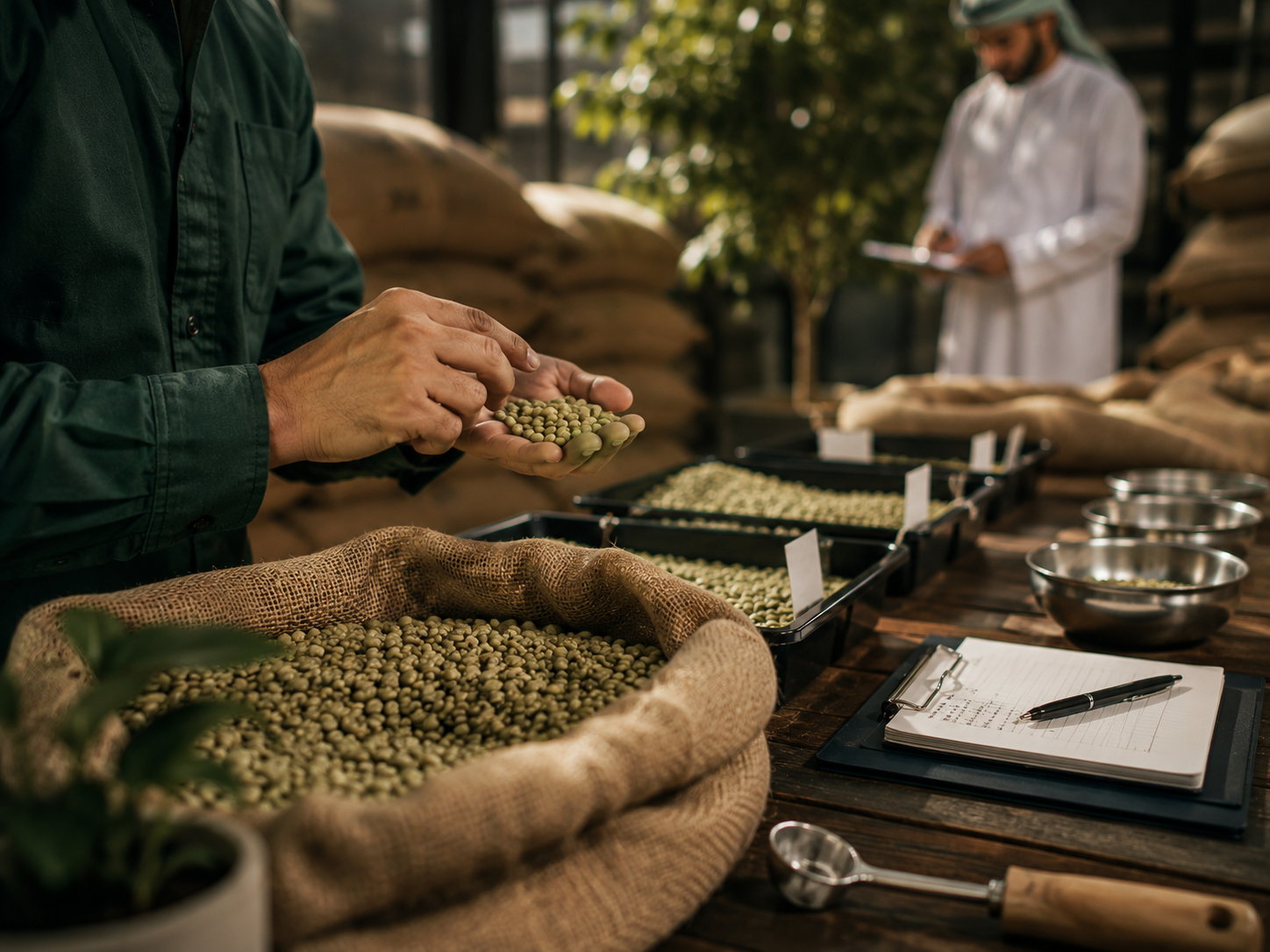
Green coffee is the foundation of every roasted coffee product, but for professional buyers it represents much more than an unroasted bean.
Understanding green coffee means looking at where it comes from, how it was processed and dried, its physical condition, its sensory characteristics, its traceability and how it has been stored before roasting.
For roasters, HORECA operators, private labels and commercial coffee buyers, these details help turn sourcing from a simple purchasing decision into a more informed evaluation of quality, consistency and suitability.
What is green coffee?
Green coffee refers to coffee beans that have been processed and dried but have not yet been roasted.
After coffee cherries are harvested, the fruit surrounding the seeds is removed through different processing methods. The coffee is then dried, hulled, cleaned, sorted and prepared for storage and export.
At this stage, the beans retain the physical and chemical characteristics that will later influence roasting and cup performance.
Processing methods
Processing has an important influence on the character and condition of green coffee.
Washed processing removes much of the fruit before the coffee is dried. After fermentation and washing, the coffee is dried until it reaches a stable moisture level.
Natural processing dries the coffee cherry with the fruit still surrounding the seed before the dried layers are removed.
Other processing approaches may use variations in fermentation, drying and mucilage removal.
For buyers, the processing method is an important part of a lot's identity because it can affect flavour expression, physical stability and the way a coffee performs during roasting.
Drying and moisture
Drying is one of the most important stages between harvest and storage.
Coffee that is dried unevenly or exposed to unwanted moisture can lose stability and become more vulnerable to physical defects or quality deterioration.
Green coffee is commonly dried to approximately 10–12% moisture before storage and further processing.
Once dried, the coffee must be protected from re-wetting during storage and transport.
Physical quality
Physical evaluation gives buyers important information before sensory evaluation begins.
The Specialty Coffee Association's Coffee Value Assessment framework includes physical characteristics such as:
Colour Defects Moisture content Bean size
Physical inspection can help identify inconsistencies in processing, preparation and storage.
The presence and type of defects can also provide useful information about the condition of a lot and the care taken throughout the post-harvest process.
Sensory evaluation
Physical appearance alone cannot describe how a coffee performs in the cup.
Professional evaluation therefore includes sensory assessment.
A descriptive sensory assessment may consider characteristics such as:
Aroma Flavour Acidity Sweetness Texture Body Aftertaste
These characteristics help a buyer understand the profile of the coffee and determine whether it fits a particular commercial requirement.
A coffee intended for espresso may be selected for different characteristics than a coffee intended for filter service, a private-label programme or a specific regional market.
Beyond a single cup score
A numerical cup score can be useful, but it should not be treated as the complete description of a coffee.
Modern coffee evaluation increasingly considers several dimensions of value together.
The Specialty Coffee Association's Coffee Value Assessment framework separates coffee evaluation into physical, descriptive, affective and extrinsic assessments.
This allows buyers and evaluators to consider not only how a coffee tastes, but also its physical condition, how its quality is perceived and the information surrounding the lot.
Traceability
Traceability helps connect a commercial lot back to the information that defines it.
Depending on the coffee and the information available, this may include:
Country of origin Region Producer or cooperative Variety Processing method Crop or harvest information Certifications Warehouse or storage point Lot reference Available volume
Not every coffee will contain every field, and traceability should never depend on information that cannot be verified.
For a professional buyer, these details help build a clearer picture of provenance, consistency and sourcing suitability.
Storage and transport
Good coffee can lose quality if storage and transport are poorly managed.
Green coffee should be kept in clean, dry and well-ventilated conditions and protected from water, excessive humidity and re-wetting.
Warehouses, pallets, bags and shipping containers all form part of the quality chain.
Careful storage helps preserve the physical and sensory characteristics established at origin until the coffee reaches the buyer.
Evaluating green coffee as a commercial buyer
A strong buying decision combines several forms of evidence.
A buyer may consider:
The origin and processing method Physical quality and defects Moisture and preparation Sensory profile Traceability information Available volume Storage location Commercial timing The intended roasting or market application
No single field should be viewed in isolation.
Two coffees can have similar sensory scores while being very different commercially because of profile, traceability, availability, processing, consistency or intended use.
From origin to buyer
Professional green coffee sourcing is ultimately about building a clearer connection between the coffee and the requirement it needs to fulfil.
Physical evaluation explains the condition of the lot.
Sensory evaluation explains how it performs in the cup.
Traceability explains where it comes from and how it reached the commercial stage.
Storage and logistics help protect that quality until delivery.
Together, these layers allow buyers to evaluate green coffee with more confidence and make sourcing decisions based on evidence rather than a single number.
At Hills Coffee, this principle supports a traceability-led sourcing approach: understand the requirement, evaluate the available lot information, request samples where appropriate and move toward a commercial decision with a clearer line back to origin.